Natural Living · Home & Garden
Coyuchi Bath Towels: How Cotton, Weave, and Weight Shape the Feel
A towel is a small domestic instrument with an unexpectedly large brief: it should meet wet skin kindly, dry at a reasonable pace, survive the laundry, and look at home hanging from a hook. When comparing Coyuchi bath towels, the useful questions are not simply whether one is “soft” or “plush.” They concern the cotton, the way the yarns are woven, the fabric’s weight, and the routines into which it must fit.
There is a moment after a shower when the bathroom is briefly its own climate. Steam lingers on the mirror; the tile is cool; a towel, if it has been chosen well, resolves the situation without fanfare. It absorbs water without feeling sodden at once, wraps without dragging, and dries before the next person in the household needs it. That modest performance depends on decisions made long before the towel reaches the rail.
For shoppers drawn to natural materials, cotton is often the starting point. But “cotton towel” describes a broad family, not a single sensation. Fiber quality and origin matter, as do yarn preparation, loop height, weave, finishing, and the weight of the finished cloth. A dense terry towel and a flat-woven towel may both be made from organic cotton and yet behave rather differently in a bathroom. One offers the familiar embrace of raised loops; the other is lighter, more compact, and often quicker to dry.
That is why a useful assessment of Coyuchi bath towels begins with the particulars of an individual style rather than a general promise. Read the material information. Look for construction and weight, if supplied. Consider care instructions and certifications. Then ask the unglamorous but decisive question: where will this towel hang between uses, and how often will it be washed?
Cotton is the beginning, not the whole story
Cotton has long served towels well because its fibers can absorb moisture and withstand repeated laundering. Yet the word alone cannot tell you whether a towel will feel crisp, fluffy, substantial, or light. Fiber length, yarn structure, and the way the cloth is made all influence the result. So do finishing choices and the density of the fabric.
When a product description identifies organic cotton, that tells you something about how the cotton was grown and, where a certification applies, how production standards were assessed. It does not by itself specify the towel’s softness, its exact absorbency, or the time it will take to dry in your particular bathroom. Those qualities emerge from the finished textile, not from a single label.
Certification details deserve a careful reading. A named standard can offer useful information about requirements in a supply chain or textile production, but it is not a substitute for understanding the product’s construction. Check which certification is listed for the towel you are considering, and do not assume that a claim attached to one item necessarily applies to every item in a collection.
For a practical comparison, note the fiber content, stated origin, certification, construction, and care instructions together. A towel made with organic cotton but woven flat has a different job from a looped terry towel. Neither is inherently the better choice. The better choice is the one whose texture and maintenance match the habits of the household.
Loops, flat weaves, and the feel of the cloth
Most people recognize terry by touch before they know its name. Its loops stand above the base fabric, creating a textured surface that can hold water and give a towel its familiar cushioned quality. Loop length, density, and yarn thickness affect how the cloth feels in the hand. A towel with a lofty surface may seem especially enveloping, while a more compact terry can feel firmer and less billowy.
Loops also bring a practical consideration: the extra surface and bulk that contribute to a plush sensation can mean more fabric to dry after use. Actual drying time depends on several variables, including the towel’s weight, the room’s airflow and humidity, and whether it is spread open or left folded over a narrow rail. A towel bunched behind a door is unlikely to dry as readily as one given room to breathe.
A flat weave presents another kind of usefulness. With no raised terry loops, the surface is generally thinner and the towel is easier to fold into a small stack or pack for travel. A lightweight flat-weave design may suit a shared bathroom, a warm climate, or anyone who would rather not devote half a laundry load to drying bulky bath linens. It can feel more textured or crisp than a plush towel, especially when new, and its character is not meant to imitate thick terry.
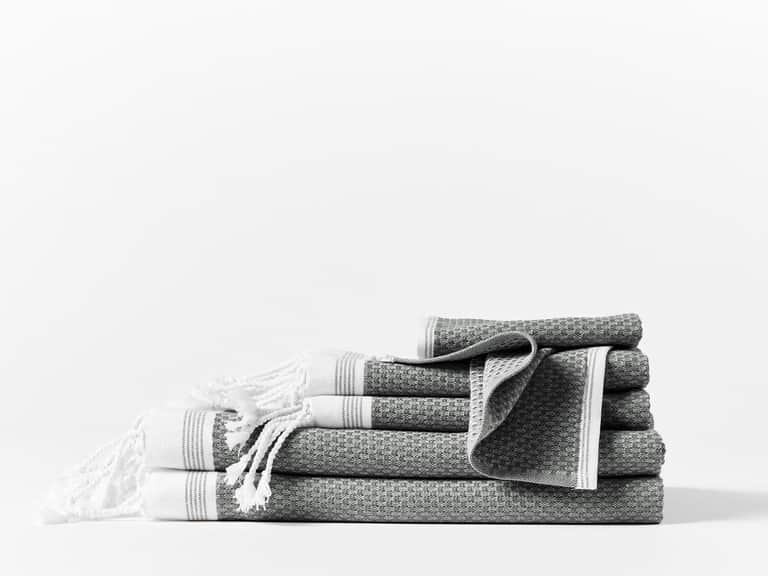
The Coyuchi Mediterranean Organic Towels illustrate the flat-weave approach. The product details describe a 100% organic cotton towel, woven in a lightweight flat construction, with a stated weight of 320 GSM. The yarn-dyed cotton, hand-knotted fringe, and crisp white edges are part of its finish; the stated origin is Turkey’s Aegean region. The style is GOTS certified and made in a Fair Trade Certified factory, according to its product information.
Those details suggest a towel designed around lightness and ease rather than the deep, padded feel associated with thick terry. Its description identifies the fabric as naturally absorbent and quick to dry, though no towel can promise the same drying experience in every home. A crowded towel rail, a humid room, or infrequent laundering can change the outcome. What the construction does make clear is the kind of trade-off to consider: less bulk and a more compact profile in exchange for a different hand-feel from a lofty looped towel.
What GSM can—and cannot—tell you
Fabric weight is often expressed in grams per square metre, abbreviated GSM. The figure describes the mass of a square metre of fabric. In towel shopping, it is a useful point of comparison: higher-GSM towels tend to feel more substantial, while lower-GSM towels are commonly lighter and easier to handle. But a number is not a verdict on quality, comfort, or how quickly a towel will dry.
The Mediterranean Organic Towels’ listed weight of 320 GSM places a specific figure beside the product’s description of a lightweight flat weave. That is helpful because it gives the shopper something more concrete than “light” alone. Still, GSM does not tell the whole story. The same nominal weight can feel different depending on yarn, weave, finishing, and the arrangement of the fabric. Nor can it tell you whether the towel will suit a small bathroom or your preference for a soft, enveloping wrap.
It is tempting to treat towel weight as a simple ladder on which heavier always means better. In reality, heavier may mean more substantial in the hand, but also more fabric to wash, store, and dry. A person who loves a thick towel and has a warm, airy laundry room may welcome that weight. Someone in a compact apartment with one narrow towel bar may prefer a lighter cloth that can be hung without occupying the room like a curtain.
Weight is most useful when interpreted alongside construction and routine. Ask whether the towel is terry or flat woven, whether you want a plush or streamlined texture, and where it will dry. If a listing does not provide a GSM figure, the omission need not end the inquiry. Product descriptions may still identify the weave and intended feel. When in doubt, consult the specific item’s current details rather than inferring weight from a collection name or a photograph.
Absorbency is more than softness
Softness makes an immediate impression, but it is not a reliable measure of a towel’s ability to manage water. A fluffy surface can feel inviting; a lighter weave can be highly functional despite a less cushioned touch. Absorbency is influenced by the cotton, the yarns, the cloth’s structure, and its finishing. It is also experienced in context: a towel used to blot rather than rub may seem different from one used to dry quickly after a swim.
Some towels feel less soft straight from the package and become more familiar with use and laundering. Others are finished to give a smoother first impression. Product descriptions can help identify materials and care, but they cannot reproduce the sensation of handling a towel. If you are comparing styles in person, notice the difference between surface softness and the fabric’s body. Does it fold neatly? Does it feel dense or airy? Does its texture seem suited to your skin and habits?
For shoppers buying online, the most reliable approach is to translate descriptive language into practical questions. “Lightweight” may indicate easier handling and compact storage. “Plush” suggests a fuller surface, but check whether the construction is terry and whether weight is stated. “Quick-drying” is relevant if towels are used repeatedly through the day, although room ventilation and hanging space still matter. A careful reading helps keep adjectives useful rather than magical.
Choose for the bathroom you actually have
The ideal towel is partly a matter of climate and partly a matter of architecture. In a large bathroom with a heated towel rail or a well-ventilated window, a heavier towel may dry comfortably between uses. In a small, damp bathroom where towels share one hook, a lighter, less bulky weave can be easier to manage. A family bathroom, where several towels cycle through the wash, has different needs from a guest room used occasionally.
Consider how you dry laundry. If the dryer is small, a compact towel may be more convenient. If you line-dry, think about available space and how air circulates around hanging fabric. If your household prefers lower-heat care, check the maker’s instructions and follow them rather than assuming that all cotton towels respond the same way. Care guidance is part of the product, not a footnote to be discovered after the first wash.
Size matters, too. A bath towel that is generous enough to wrap around one person may be cumbersome for another to fold or store. Towels used at a gym, pool, or on a trip may benefit from a lighter, more packable construction. For everyday bathing, comfort may take priority over portability. Matching the towel to its main use is a simple way to avoid buying an appealing object that spends most of its life inconveniently damp.
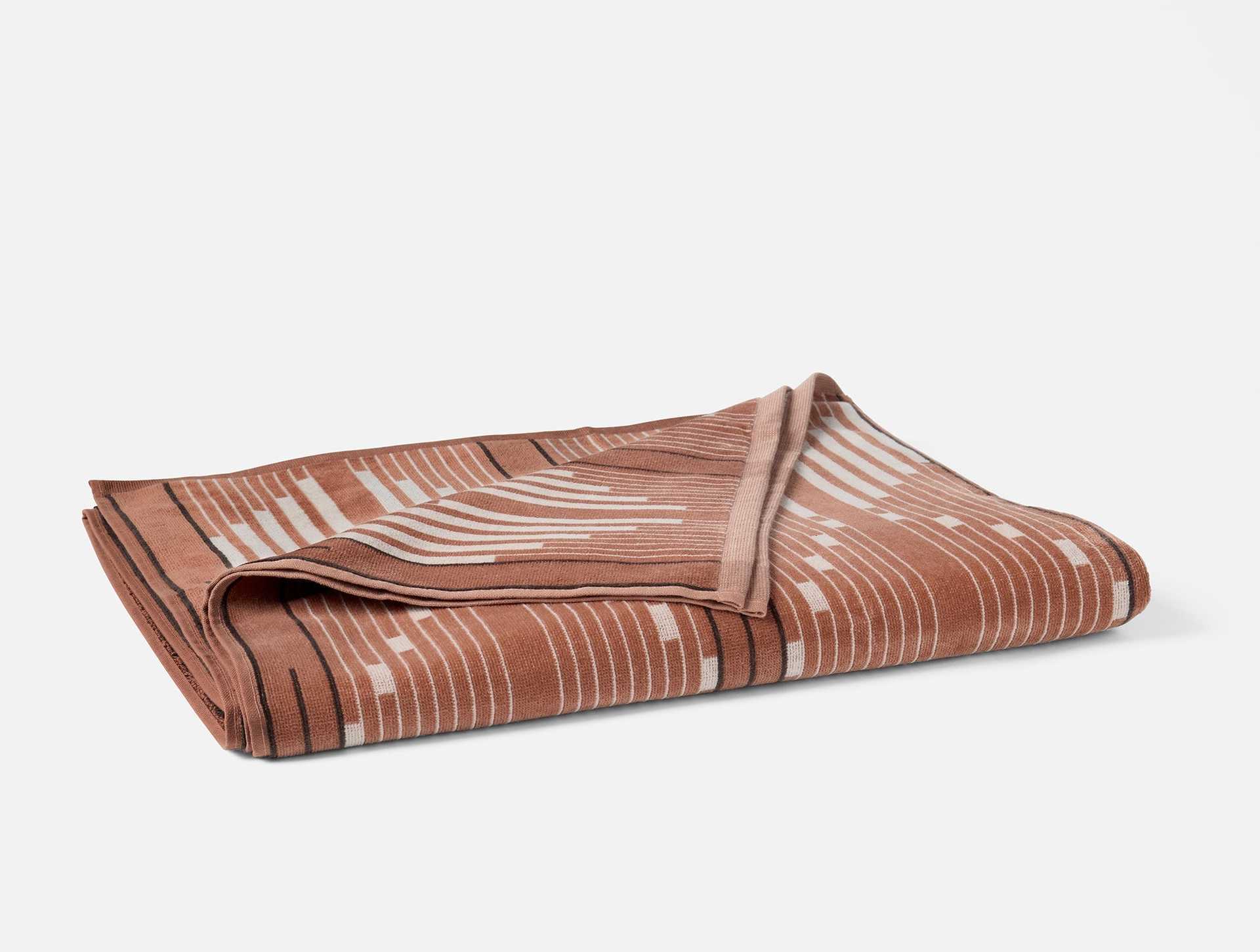
Color and finish have practical consequences of their own. Yarn-dyed stripes or contrasting edges can make a towel visually distinctive, while a restrained palette may blend more easily with existing linens. Fringe adds a decorative detail but should be considered in the context of laundering and daily wear. None of these choices replaces construction as the central question, but they help determine whether the towel will feel at home in the room.
Care is part of the buying decision
A towel’s life is a cycle of use, dampness, washing, drying, folding, and use again. The care label offers a realistic account of how the maker recommends moving through that cycle. For the Mediterranean Organic Towels, the listed instructions are to machine wash cold on a gentle cycle with like colors, tumble dry low, and remove promptly; warm ironing is optional. Those specifics are more useful than a vague assumption that every cotton towel can be treated identically.
In daily use, give towels space to dry. Spread them across a rail or hang them so that air can reach more of the cloth. Avoid leaving a damp towel folded into a heap. Wash according to the care label and the needs of your household, using an appropriate detergent amount. Overloading a washer or dryer can interfere with movement and airflow, while excessive heat may be harder on textiles over time. The instructions supplied for the particular towel should take precedence over general rules.
Do not judge a towel’s long-term feel by a single wash. The way a textile changes depends on its construction, laundering, water, detergent, and drying method. If a care label advises low heat, high heat is not a shortcut to softness; it is simply a different treatment. Consistent, sensible care is generally kinder to fabric than a series of improvised experiments.
Think about drying habits before purchasing, especially if you are drawn to a heavier towel. A plush towel can be a pleasure when it is dry and available. Its practical value declines if it remains damp because the bathroom has little airflow or the rail is crowded. Conversely, a lighter flat-weave towel may be convenient for frequent turnover, though its surface will not provide the same cushioned sensation as substantial terry. Neither choice is a moral achievement. It is a question of fit.
A calm way to compare Coyuchi bath towels
Online descriptions often place material, construction, origin, certification, and care in separate lines. Bringing those facts together makes comparison easier. Start by deciding what sensation you want: a towel with loops and a fuller feel, or a flat weave that is light and compact. Next, look for stated weight. Then consider the drying space and laundry routine that will govern how the towel performs once it is in use.
- Read the fiber details. Confirm the listed material and look for a specific certification when that information matters to you.
- Identify the construction. Terry loops, flat weave, and other textile structures create different surfaces and levels of bulk.
- Use GSM as a clue, not a score. A weight figure helps describe the cloth but cannot independently predict softness or your drying time.
- Match the towel to its setting. Shared bathrooms, travel, guest rooms, and everyday use may call for different sizes and weights.
- Check the care instructions. Washing and drying requirements affect convenience as surely as the initial feel does.
- Read the listing for the exact style. Materials and construction can vary among towels, so do not generalize from one product to another.
Applied to the Mediterranean Organic Towels, that method yields a fairly clear portrait: organic cotton, a flat weave, 320 GSM, yarn-dyed color, hand-knotted fringe, and care instructions calling for a cold gentle wash and low tumble drying. The listed certification information includes GOTS certification and production in a Fair Trade Certified factory. Those particulars do not settle whether the towel is right for you; they help make the decision legible.
Someone who prizes a thick, cloudlike towel may prefer to seek a style whose construction and description point toward a fuller terry feel. Someone who values a light profile, easier packing, and a less bulky laundry load may find the flat weave more appealing. The right answer depends less on an abstract hierarchy of towel quality than on whether the cloth answers the ordinary demands placed upon it.
The quiet pleasure of a useful textile
Good household objects rarely announce their usefulness. A towel becomes part of the background until it is missing, too damp, too small, or suddenly uncomfortable against the skin. The best choice is therefore not necessarily the most dramatic one. It is the towel whose texture makes sense at the end of a shower, whose weight suits the room, and whose care does not turn laundry day into a negotiation.
Cotton, weave, and weight offer a practical vocabulary for making that choice. Cotton tells you what fiber is named; certifications can add information about specified production standards. Weave helps explain the surface and structure. Weight provides a comparative sense of substance. Care details reveal what the towel asks of you after purchase. Together, these details offer a more dependable guide than softness alone.
When assessing Coyuchi bath towels, begin with the actual product information and picture the towel in the life it will lead: damp on a rail, folded in a cupboard, washed with the rest of the household linen. A lightweight flat weave and a plush terry towel are not rival answers to one question. They answer different questions. Choosing well means knowing which one your bathroom has been asking.