Pillows & Natural Materials
How to Compare Natural Pillow Fills: Wool, Latex, and Down
A pillow can be soft without being yielding, supportive without feeling rigid, and natural without being the right choice for you. Wool, latex, and down each have their own ideas about comfort. The useful comparison begins not with a promise on a label, but with the way you sleep.
A pillow seems a modest piece of household equipment until it is wrong. Then it becomes a nightly argument: with the neck, with the mattress, with the hour. It may collapse just as sleep arrives, prop the head at an implausible angle, or hold heat in a way that makes a quiet room feel suddenly close. The right fill will not solve every sleep problem, but it can make the small geography between shoulder, head, and mattress more agreeable.
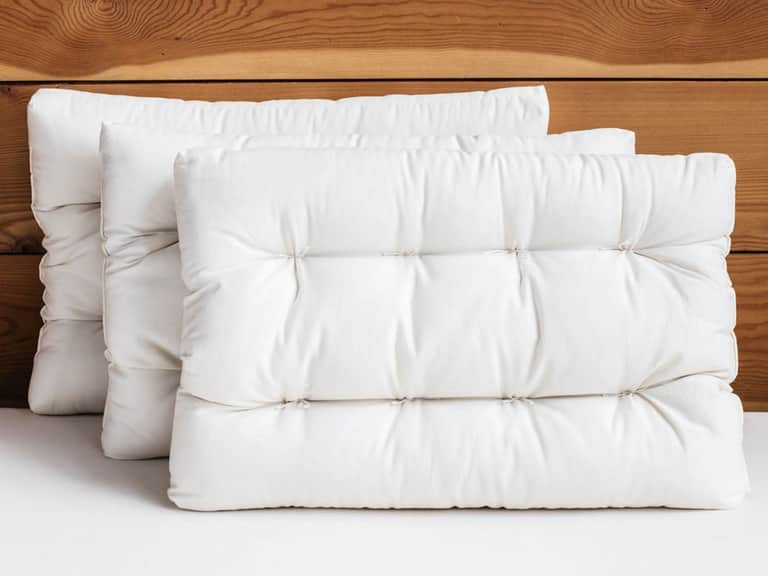
Wool, latex, and down are often grouped under the broad heading of natural pillow fills. That shared label can obscure how differently they behave. Wool has a springy, somewhat substantial feel and is valued for managing warmth and moisture. Latex is resilient and buoyant, returning toward its original shape after pressure. Down is light and pliable, famous for a soft, enveloping loft that can be shifted and fluffed. None is a universal winner. The choice depends on support, sleeping position, temperature, care, sensitivities, and the materials surrounding the fill.
It also helps to distinguish a material’s properties from a product’s marketing. “Natural” does not, by itself, tell you how a pillow will feel, what percentage of its contents are natural, whether the cover is certified, or how the item should be cleaned. Reading a specification is less romantic than picturing a cloud or a meadow, but it is more likely to lead to a pillow you can live with.
Begin with loft and sleeping position
Loft is the pillow’s height under the head, though the number a maker gives for an uncompressed pillow may not describe its height in use. Fill density, construction, and the sleeper’s weight all affect what happens once the head settles in. A high-loft pillow can be a useful bridge for a side sleeper whose shoulder leaves a larger gap between head and mattress. The same height may tilt a back sleeper’s head forward. A stomach sleeper, who generally needs less elevation, may find even a soft, full pillow too much.
These are starting points, not laws. Shoulder width, mattress firmness, body proportions, and habit matter. A broad-shouldered side sleeper on a firm mattress may need a different pillow from a narrower person sleeping in the same position on a softer surface. If you wake with discomfort, the cause may not be the fill alone; pillows are one part of a larger sleep arrangement.
Consider whether you want the pillow to hold a fairly consistent shape or to move around you. Latex tends to supply a more defined, buoyant platform. Wool has a springier, more yielding structure, though its firmness and loft depend on the amount and arrangement of fill. Down is usually the most readily compressed and reshaped of the three. Some sleepers enjoy that give; others find themselves rebuilding the pillow during the night.
Wool: resilient, breathable, and substantial
Wool fibers have a natural crimp that helps them spring back after compression. In a pillow, that quality can translate into a supportive feel that is not quite as firm or uniform as a molded core. Wool also absorbs and releases moisture, a property often appreciated by sleepers who dislike a clammy surface. Its temperature behavior is not a guarantee of coolness—bedroom climate, pillowcase fabric, and individual physiology all matter—but wool’s ability to handle moisture is part of its appeal.
Wool pillows tend to feel more structured than down, with less of the loose, billowing softness associated with a featherbed. They may suit people who want some give but prefer a fill that does not simply flatten into a thin layer. As with any pillow, however, “wool” tells only part of the story. The amount of fill, the pillow’s dimensions, and whether the interior can be adjusted all help determine its loft and support.
Care is a practical consideration. Many wool-filled pillows are spot-clean only, while a removable cover or case may be washable. That distinction matters: the washable outer layer is not necessarily the pillow itself. Regular use of a washable pillow protector can help keep oils and perspiration away from the fill. Always follow the maker’s instructions; soaking or machine-washing a pillow that is not designed for it may distort the filling or make thorough drying difficult.
For a shaped example, the All-Natural Orthopedic Neck Pillow uses Premium Eco Wool in organic cotton fabric and has bolsters along both long edges, with one side more heavily filled. Its design is more specialized than a conventional rectangular pillow, so it is best assessed for the intended resting position and the sleeper’s comfort rather than assumed to suit everyone. The listed care guidance is spot-cleaning for the pillow, with the removable case washed separately.
Latex: buoyant support that keeps its shape
Latex has a different temperament. Rather than settling deeply around the head, it tends to push back gently, creating a springy, responsive surface. That resilience can make latex appealing to sleepers who want consistent support and do not want to fluff or reshape a pillow often. A latex pillow may also recover its form more readily than a loosely filled one, although durability depends on construction, use, and care.
There are meaningful differences between latex designs. A solid, shaped core can provide a stable contour; an aerated core may include openings intended to encourage airflow; shredded latex behaves more like a loose fill and may feel more pliable. “Latex pillow” is therefore a category, not a single sensation. A description should identify whether the fill is solid or shredded and explain the cover, dimensions, and care requirements.
Position remains important. A supportive latex pillow can work well for some side or back sleepers, but a particular contour or loft may not suit every neck or shoulder. If possible, compare the height and shape with your current pillow rather than relying on a broad claim about alignment. A pillow can be well made and still be the wrong height for a particular body.
Latex care often differs from ordinary laundry. Some pillows have removable, washable protectors, while the latex itself is meant to be spot-cleaned and kept dry. Direct heat and strong sunlight may be discouraged by manufacturers. A protector can help extend the interval between cleanings, but it does not make the core machine-washable.
The Turiya Organic Latex Pillow is described as an aerated Dunlop latex design with indentations for the head and ears, and includes an organic cotton inner cover and removable protector. The Naturally Organic Hudson Shredded Latex Pillow uses shredded Dunlop latex in an organic cotton cover. The latter product information notes that the pillow is not adjustable, an important reminder that shredded fill does not necessarily mean the user can add or remove material.
Down: lightness, softness, and easy reshaping
Down is the soft underlayer beneath the outer feathers of waterfowl. In a pillow, its clusters trap air and create loft with relatively little weight. The result can feel plush and supple, with the fill shifting readily under pressure. People who like to fold, bunch, or knead a pillow into place often appreciate this quality. Down may also feel luxurious in the old-fashioned sense: not because it is especially firm, but because it yields.
That softness has a trade-off. Down can compress more than latex and may require regular fluffing to restore its volume. Support depends on the pillow’s construction, fill quantity, and the balance of down with feathers, if any. A label that gives a down percentage and fill power can offer useful information, but it does not replace an individual sense of comfort. Fill power describes the volume occupied by a given weight of down under a testing method; it is not a direct measure of whether a pillow will be soft, firm, or appropriate for a particular sleeper.
Care instructions should be checked carefully. Some down pillows are washable, but drying them thoroughly is essential, and the manufacturer’s directions take precedence. Others may call for professional cleaning. A washable pillow protector is useful here too. People with known sensitivities to down or feathers should consider those concerns before choosing this fill; “hypoallergenic” language varies, and no label can promise that an individual will have no reaction.
One example is the Goose Down Pillow, described as containing 90 percent white goose down and 10 percent white goose feather, with an organic cotton shell and a stated fill power of 800. Its listed care is a cold, gentle machine wash followed by low-heat tumble drying. Those details make it easier to compare with other down pillows, but they do not predict whether its softness or loft will suit a particular sleeper.
A closer comparison
| Consideration | Wool | Latex | Down |
|---|---|---|---|
| Typical feel | Springy, substantial, gently yielding | Buoyant, responsive, more structured | Light, soft, compressible, easy to shape |
| Shape retention | Resilient; varies with fill and construction | Generally strong, especially with a solid core | Often needs fluffing to restore loft |
| Common care approach | Often spot-clean the pillow; wash cover separately | Usually spot-clean the core; protectors may be removable | May be washable or require other care; check directions |
| Questions to ask | How much fill? Is the cover removable? | Solid or shredded? What is the loft and contour? | What is the down-to-feather ratio? What does care require? |
The table describes tendencies, not guarantees. A dense wool pillow may feel firmer than a loosely filled one; shredded latex may feel less uniform than a molded core; and a down pillow’s behavior can change with its fill composition and casing. Product construction is the quiet variable running through every comparison.
Read the cover and the certification, too
The cover is not merely a wrapper around the fill. It influences how the pillow feels against the face, how well it breathes, whether it can be removed for washing, and how securely the contents stay in place. Cotton is common in natural bedding; sateen and percale, for instance, have different surface textures. A zippered inner cover may protect the fill, while a separate protector can make everyday care simpler. Check whether a product listing describes an inner cover, a removable protector, a pillowcase, or some combination of the three.
Certifications can clarify certain parts of a product’s story, but they should be read precisely. GOTS concerns organic textile processing and related criteria across a textile supply chain; GOLS applies to organic latex products and their processing. Neither label is a substitute for a full ingredient or materials list, and a certification for one component should not be assumed to cover every part of the pillow. Look for the named standard, the material it applies to, and any stated origin or manufacturing information.
Clear disclosure is useful even when a product does not carry a certification. A careful description identifies the fill, shell, construction, country of origin where available, and cleaning instructions. Vague phrases such as “all natural” may sound reassuring while leaving the practical questions unanswered. The aim is not to make a label do more than it can; it is to gather enough concrete information to compare like with like.
Choose for your habits, not an idealized sleeper
Before buying, notice what you already do. Do you fold your pillow in half? Push the filling away from your face? Wake up hot? Put the pillow in the wash frequently? These small habits are more revealing than an abstract preference for “soft” or “firm.” If you want a pillow that stays in a defined shape, a resilient latex construction may be worth considering. If you prefer a little spring and are attentive to temperature and moisture, wool could be a fit. If you like a pillow that can be molded and fluffed, down may feel more natural to you.
Then check dimensions and loft, and compare the care label with the way you actually maintain bedding. A pillow that requires delicate handling may be a poor match for someone who expects to wash the entire item routinely. Conversely, spot-cleaning may be perfectly manageable when the pillow is protected with a washable case. Think about sensitivities and household needs as well, and do not treat a material’s natural origin as proof that it is suitable for every person.
- Match loft to your position, shoulder width, mattress feel, and personal comfort.
- Identify the exact fill and construction: wool, solid or shredded latex, or the down-and-feather ratio.
- Check whether the cover or protector is removable and what parts can be washed.
- Review certifications by name and confirm which materials they cover.
- Use a return or trial policy, if offered, to assess comfort over more than a few minutes.
The answer is a matter of fit
Natural pillow fills offer different forms of comfort rather than a hierarchy. Wool brings spring and moisture management, latex a more buoyant sense of support, and down a light softness that can be shaped and rearranged. Each asks for something slightly different from its owner: attention to loft, tolerance for a particular feel, or a willingness to follow specific care instructions.
In the end, the best pillow is less a declaration of values than an arrangement that lets the body settle without prompting a nightly negotiation. Read the material details. Consider how you sleep. Be skeptical of claims that turn a complex object into a cure-all. Then choose the fill whose ordinary behavior—the way it compresses, rebounds, warms, and needs to be cared for—makes sense in your ordinary life.